
 + points earned!
5 Simple Home Changes to Help Your Elderly Loved Ones Age Safely
- 21 August 2026
- Home Nursing Foundation
As our loved ones grow older, most prefer to age in place at home. What is ageing in place? It simply means being able to live safely and independently in their own home as they grow older, rather than having to move to a nursing home. The familiar environment and people can provide them with a sense of security. Yet, their home may not be adequately equipped to provide a physically safe environment for them as they age.
Senior-friendly home modifications in Singapore can make your house much safer and more comfortable for your elderly loved one. These changes don’t have to be expensive or complicated - our list includes modifications that you can do yourself or with the help of a specialised installer.
These five simple home modifications can help your loved ones age better in place.
Change #1: Prevent falls with non-slip flooring and clear walkways
Falls in the elderly are the leading cause of old-age trauma presenting to the emergency department in Singapore, accounting for as much as 85% of all cases.
What causes the elderly to fall? A combination of factors: age-related weakening of the body's muscles, balance problems, and slower reaction times, combined with home obstacles and slippery flooring.
These pointers can help with elderly fall prevention at home:
● Cover slippery tiles with non-slip mats or flooring
Glossy and polished ceramic or marble tiles can become very slippery when wet. Sometimes, this may be caused by worn-out tiles. But you don’t need to replace the tiles completely, because hacking away old flooring is often noisy, dusty, and expensive.
Under the EASE (Enhancement for Active Seniors) programme, which covers both HDB flats and private properties, you can access significant subsidies for slip-resistant treatment to the flooring in your toilet and bathroom. View the qualification requirements, subsidised costs, and methods of application here.
If you stay in a HDB unit, you may want to wait for the HIP (Home Improvement Programme) upgrading period to install non-slip tiles under the subsidised, optional toilet upgrading package.
In the meantime, you can consider these options: placing anti-slip mats or installing overlay non-slip flooring.
The most straightforward method is to lay a few anti-slip floor mats in your bathroom so your loved one can stand on them while showering and dressing. Other areas where you can place non-slip floor mats include the kitchen, bedroom, and walkways.
If you’d prefer something more permanent, contact a flooring installer who can help you assess the condition of your current tiles and layer nonslip vinyl or laminate over your old flooring to create a high-friction surface.
This type of overlay flooring is popular in HDB flats for its cost-effectiveness and lack of noisy hacking, and you can also choose to overlay non-slip flooring for the rest of your home.
● Secure or remove loose floor carpets
Is a carpet a trip hazard for the elderly? Yes, if it’s not secured properly, as loose rugs or carpets can bunch up under walkers or shuffling feet. Either remove them or firmly secure the undersides with double-sided carpet tape (available online or at a hardware store).
You can also place carpets over a non-slip rug pad, but make sure to choose one with a natural rubber backing so it has a grip on your laminated or tiled floor.
● Keep pathways free from clutter
How does a walking aid reduce fall risk? It gives them the extra support needed to move around the house independently. There are different types of walking aids, and suitability should be assessed by a physical therapist to avoid using a walking aid that isn't appropriate for your loved one.
- A standard walking stick/cane is best for seniors who only need slight balance assistance.
- Quad-stick canes with four legs around the base provide more stability than a standard walking cane. They're suitable for seniors who need more support.
- A walking frame or walker has a lightweight yet sturdy metal frame that provides the most support for a senior who needs help with balancing on both sides.
- Rollators are similar to a walking frame or walker, except that the base has four wheels. It's recommended for seniors who don't have the strength to lift a walking frame.
Regardless of the type of walking aid used, your loved one will need clutter-free walkways to navigate their way safely.
Try to remove any loose clutter, such as shoes, boxes, chairs, and shopping bags, from the floor to create a clear pathway. Secure long electrical cords with floor cord covers (available online or at hardware stores) and keep them taped close to walls rather than placed across walkways.
For more tips, download our Fall Prevention Booklet from the Carers Hub resource library, available in English and Chinese.
Change #2: Improve lighting throughout the home
You might wonder, are the elderly with dementia prone to falls? The answer is yes, and environmental factors such as poor lighting play a role.
Ageing eyes need brighter light to see clearly due to changes in the eye structure as one gets older. Dimmer lighting may be great for ambience and cosiness, but it can reduce visibility for your senior loved one.
For a senior with dementia, cognitive decline affects their depth perception, balance, and judgement. Uneven lighting can create shadows that either appear to be obstacles or conceal actual obstacles, increasing the risk of trips and falls.
These tips help you improve lighting and light-switch accessibility:
● Install brighter LED lighting
LED lighting is the best choice for achieving bright, even light. You can find LED bulbs in different sizes online or at supermarkets and hardware stores. Choose cool white or daylight instead of warm (orange or yellow) lighting for the best illumination.
● Add night lights in hallways and bathrooms
Consider placing night lights between the bed and bathroom to make night-time toilet trips easier. Choose plug-in, battery-powered, or USB-powered lights (available in different sizes and designs online, e.g. IKEA smart lighting) so you can shift them around as needed, rather than installing them permanently on your walls.
● Mount accessible light switches
Use contrasting colours for light switch boxes. Ensure they’re mounted at eye-level, which is around 100cm from the floor, to be accessible if your loved one uses a wheelchair.
These switches should also be arranged in a way that feels most intuitive to your loved one. Place them along walls that align with their daily routines and habits.
For example, if they naturally move toward the right-side wall when entering their bedroom, it is much safer and more intuitive for them to reach out for a switch there, rather than making them navigate toward a switch on the left-side wall in the dark.
● Using motion-sensor lights for convenience and safety
Motion-sensor lights help reduce fall risk by automatically illuminating the room when your loved one gets up at night. Choose a portable model with an adjustable timer to ensure the light stays on long enough for them to safely reach and return from the bathroom.
Some areas where you could place the motion sensor lights at are:
- Under the bed frame or at the foot of bed to activate when they step off the bed and walk away from it.
- Along wall skirting boards on the way to the room exit, so they illuminate the path there.
- At the entrance of the toilet, which helps them locate the door handle and mind their step when entering the bathroom.
- Next to the toilet bowl and beside the sink, to help them see clearly when sitting down or standing up to wash their hands.
Change #3: Rearrange furniture for easier navigation
You may need to rearrange furniture to make room for wider walkways around the house:
● Create direct sightlines
Move tall furniture, such as room dividers, screen partitions, and shelves, flush against the wall rather than placing them in the middle of the room. Your loved one should be able to see across the whole space to know where they’re going. Having a direct sightline increases confidence and reduces anxiety.
● Avoid sharp-edged furniture in tight areas
Sharp-edged furniture, such as cabinets and tables, can cause injuries to the legs and hips. If you can’t replace the furniture, use silicone corner protectors to soften the impact.
● Consider built-in storage
Wall-mounted or built-in cabinets and shelves can help free up floor space. However, ensure your loved one’s essentials and frequently used items are stored on shelves or at near waist and shoulder height to prevent overreaching or bending.
● Create accessible seating areas
- Place a shoe-changing chair near the front door.
- For the sofa, avoid plush, deep-cushion seating that is hard to get up from.
- Consider installing a grab bar beside the seating area or sofa to provide something sturdy for them to hold onto, when getting up or down from the chair.
- Choose chairs in colours that contrast with your flooring to help your loved one locate the seat easily.
- Avoid using flimsy folding chairs, low ottoman stools, and swivel chairs, as they pose a risk of collapsing, sliding, or being too low for your loved one to sit securely.
● Ensure the bed is at a suitable height
Ensure the bed height is low enough for your loved one to place both feet flat on the floor when seated on the edge. Their knees should also bend at a 90-degree angle when their feet are flat on the floor.
Change #4: Install grab bars in bathrooms
We previously mentioned that adding non-slip flooring is a crucial step when considering how to prevent falls in elderly family members. Grab bars provide added physical leverage to help your loved one navigate the toilet and shower safely.
● Install grab bars near toilets and showers
When looking for quick safety fixes, many people ask: do suction grab bars work? The reality is that suction bars, although faster to install, are highly prone to slipping on wet tile and are not safe for holding a person's full weight. Instead, permanently anchored bars are better.
The EASE (Enhancement for Active Seniors) programme, which covers both HDB flats and private properties, provides significant subsidies for installing sturdy grab bars in your home. View the qualification requirements, subsidised costs, and methods of application here.
For HDBs, the senior must be 65 years or older, or 60 to 64 years old and require assistance with at least one Activity of Daily Living (ADL). Subsidised costs vary depending on the size of your flat. Apply via the HDB e-Service or Mobile@HDB app.
For private properties, eligible households will receive $1,200 in vouchers under EASE (Private) to cover 75% of the installation costs of selected senior-friendly fittings, including grab bars. View costs and application instructions here.
- How high should grab bars be installed? ADA standards for accessible design state that horizontal grab bars must be installed 84 to 91cm from the finished floor line, measured to the top of the gripping surface.
- Where should grab bars be installed? They are usually installed along high-risk zones such as the toilet bowl and shower area.
- Where to install a grab bar in a HDB toilet? These are usually installed on the wall closest to the toilet.
● Consider shower chairs and raised toilet seats
A shower commode can help wheelchair users with showering. If your loved one can stand but not for extended periods, you can place a shower chair in the bathroom for them to shower while seated. A good shower chair for seniors should have non-slip rubber feet, drainage holes, and height-adjustable legs.
A raised toilet seat can also minimise knee bending for seniors who have muscle weakness or joint issues. You can find these in specialised elderly care and medical supply stores in Singapore, e.g. The Golden Concepts, SeniorCare
Change #5: Make everyday tasks more accessible
Small accessibility improvements, such as changing doorknobs, can make everyday living easier for your loved one. Consider:
● Lever-style door handles and taps
Round doorknobs and taps that require them to grab and twist them may be difficult to use if they have weak grip strength or arthritis. Up-and-down lever-style door handles and taps are easier to use. You can contact a plumber and locksmith to help you replace these fittings in your house.
● Smart home devices or voice-controlled lighting
Smart home devices can help your loved one switch on the lighting and the television without having to navigate the house to reach a switch. Connecting smart Wi-Fi switches to your lights or electrical appliances lets you or your loved one control them with a mobile phone or via voice activation. For example, they can use their phone to switch on lights before stepping into the house.
● Sliding door cabinets and hydraulic pull-down baskets
Sliding-door cabinets are easier to open and close than swing-type doors. For overhead storage, consider hydraulic pull-down baskets that provide access at shoulder level without climbing or overreaching.
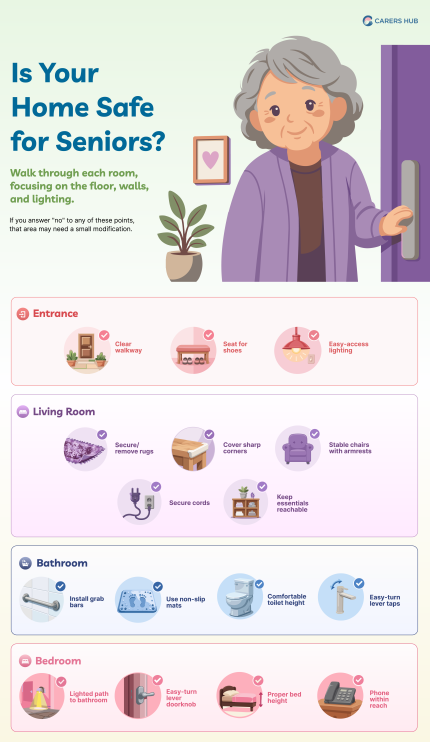
Refer to our home safety infographic above to help you check whether your house is senior-friendly.
This video resource also offers additional tips for creating an elder-friendly home, with advice from an occupational therapist.
While HNF doesn't officially endorse or sponsor any specific brands, we’ve included a few examples as a helpful starting point. Feel free to use whatever brands work best for you.
References:
https://www.floorrich.com/overlay-flooring-what-it-is-and-why-it-s-popular-in-singapore-homes-2/
https://thelnflooring.com/blog/overlay-flooring-hdb-singapore
https://www.reddit.com/r/askSingapore/comments/15tg4ti/any_recommendations_for_making_my_bathroom_less/
https://www.rugpadusa.com/articles/how-to-keep-a-rug-in-place-on-wood-floors?srsltid=AfmBOoqeoIbl21ePexvna9FHEsqv9Lb3ddU-re4l6uyqo47hIa9iBuUS
https://riverbendal.com/the-benefits-of-led-lighting-for-seniors/
https://www.lifeline.com/blog/how-motion-detector-lights-can-help-seniors-avoid-falls/
https://shelbydesigncenter.com/blog/lighting-for-aging-in-place-enhancing-safety-and-accessibility
https://www.aic.sg/Caregiving-Support/Making-Your-Home-Safe
https://www.alamiclinic.com/blog/home-safety-audits-ensuring-a-secure-environment-for-elderly-loved-ones
https://www.cellini.com.sg/blogs/guide/design-an-elderly-friendly-home?srsltid=AfmBOoo_zWTiOckXCDCLTr-cEIFl3JYs_4PNDwtZq2OFcQEXADX1RN5d
https://www.101mobility.com/blog/the-importance-of-grab-bars-for-home-safety-and/
https://www.thegoldenconcepts.com/blogs/eldercare-equipment/useful-tips-where-to-install-grab-bars-in-your-home?srsltid=AfmBOoqq6aXHcbWn9OVC22FVvT7nrjL0An1iIOp_6_NRLkhCrUx1Xh7x
https://eamobility.com/7-benefits-of-a-high-toilet-seat-for-the-elderly-a-must-have-for-safety-and-comfort/
https://www.decorhandles.co.za/blogs/news/choosing-the-right-door-handle-for-the-elderly-and-arthritis-patients?srsltid=AfmBOorXURx7OtowjP91S2rij01Opv4SSHzB46bA27ACO2Q5rc8ZJ3eg
https://www.nytimes.com/wirecutter/reviews/smart-home-for-seniors/
https://www.beyondorganising.com.au/blog-1/safe-and-functional-homes-essential-organising-tips-for-elderly-individuals
https://artofdrawers.com/inspirations/aging-at-home-how-to-make-home-safe-for-older-adults/
https://caringseniorservice.com/blog/home-organization-tips-for-seniors/
https://www.homage.sg/resources/mobility-aids/
You may also like
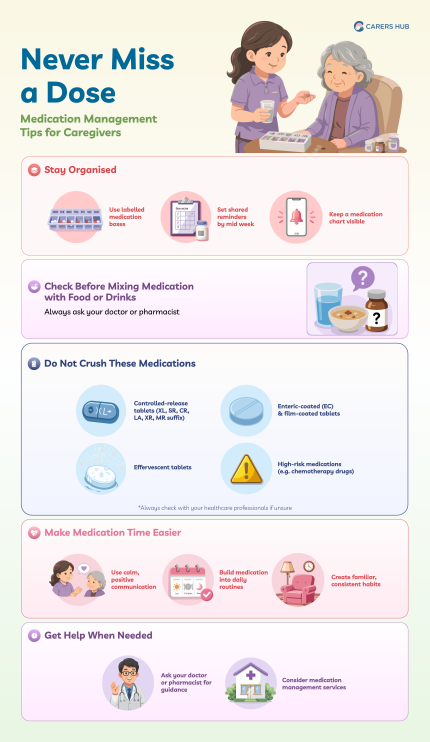
Never Miss a Dose: Medication Schedule Management Tips for Caregivers + Free Template

Senior Citizen Discounts and Benefits in Singapore: Groceries, Transport