
 + points earned!
Never Miss a Dose: Medication Schedule Management Tips for Caregivers + Free Template
- 28 August 2026
- Home Nursing Foundation
Seniors living with long-term medical conditions may require many different types of medication. As a caregiver, you’ll need to track and administer them at the correct time and dosage. It’s common for caregivers to worry about missed doses, giving medication at the wrong time, potential harmful medication interactions, and coordinating medication schedules between caregivers (such as between you and your domestic helper).
This guide is here to help you make that easier. You’ll find simple, practical tips designed to help you establish an effective elderly medicine schedule and reduce daily worry about medication consistency. We’ve also shared a free template you can print out at the end of this article.
Tip #1: Use external tools to help you stay on track with medication
We usually rely on memory to help us remember when to take medication, especially for simple daily supplements and one-off medicines for flu and fever. However, medication for long-term medical conditions can come in different forms that require different steps, equipment, and preparation time.
For example, respiratory conditions may require inhalers and nebulisers, while patients with diabetes require insulin injections.
Relying on memory for everything may not be the most ideal option in such cases. It can cause increased stress and anxiety about whether you’ve missed anything.
Instead, rely on visual tracking tools. Keeping your schedule simple and highly visible is the most ideal way to reduce mistakes in both dosage and timing. These methods can help:
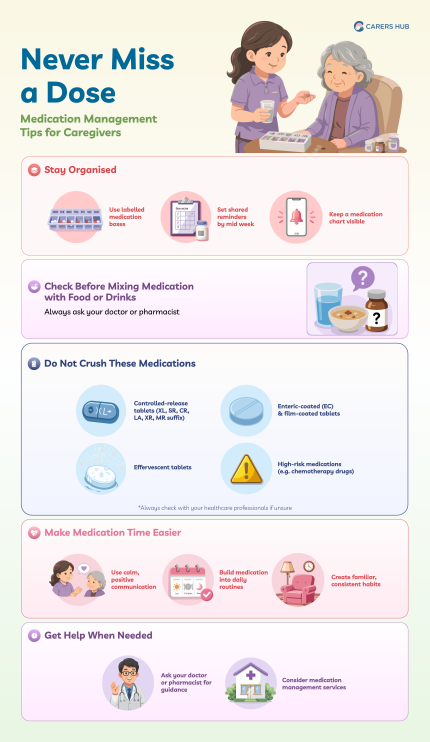
● Using labelled medication boxes
Medicine dispensers for the elderly, such as portable pill boxes and larger storage boxes for bottles, are excellent for separating different types of medication.
Set up a dedicated ‘medicine corner’ at home in a cool and dry place. Label each box clearly with the dosage amount and time (you can also include instructions in your domestic helper’s native language to help them easily identify the medication). This makes it easier for everyone to remember what needs to be administered and when.
To make this system stronger, consider:
- Place instructions inside the box specifying the dose time and critical information such as ‘must take after food’, ‘must inject before meals’.
- Use a visual indicator to show whether the dose is taken. Place a double-sided card inside the box: flip it to green when the medicine is taken, and leave it on red when the dose is pending. This simple trick provides immediate visual proof and prevents any miscommunication when handing off medication duties to a domestic helper.
- Dedicate one specific day each week to check and refill all the organisers. Building this into your weekly schedule ensures it becomes a habit, preventing any confusion over whether the boxes have already been stocked for the week ahead.
● Set up reminders for everyone
Sync reminders across devices (between your devices or between yours and your co-caregivers) so everyone knows when medication needs to be administered. You can use apps like Google Calendar and share it with everyone involved.
When the reminder notification pops up, everyone will receive it at the same time. Whoever is caring for your loved one can administer the medication and then inform everyone once they’re done. This helps prevent repeated or missed doses.
● Consider a pill box with a built-in alarm
A pill box with a built-in alarm can act as both a medicine storage organiser and a reminder. Models like this one let you input up to five separate alarms daily, with six pill compartments. The alarms have vibration and sound, ensuring that you, your helper, or your loved one will get the reminder to take medication. You can find such pillboxes on various online shopping platforms.
● Keep a printed medication chart in a visible area
In addition to the medication labels and instructions in each storage box, you can create a master medication chart that lists all instructions, dosage times, and medication names. Hang this chart in a high-visibility area, such as the living room or kitchen fridge, so that any caregiver can get a full overview of the daily medication routine at a glance.
You may use the example template included at the end of this article.
Tip #2: Managing medication fatigue
When your loved one resists taking their medication, it can help to try and identify the root cause first:
• Thinking that there's no improvement: If they see no immediate improvement in symptoms, they may think that there's no point in taking the medication. You could try to explain that these medications take a longer time to work, and they often work quietly in the background to prevent the medical condition from worsening.
• Pill fatigue: Your loved one could be getting tired of taking lots of pills, especially if they have difficulty swallowing (dysphagia). You could try asking the doctor or pharmacist for ways to space out the dosage, so they don't have to take all the medication at once.
To help make medication time easier, try pairing it with a familiar routine, such as their favourite breakfast or a television programme they watch every morning. Doing so helps integrate it more seamlessly with their daily schedule, instead of a chore they must make time for.
Tip #3: Consider your loved one’s individual preferences around taking medication
Every senior has unique habits, routines, and emotional responses to taking medication. It is completely normal for seniors to dislike and even resist taking their medication. You might wonder how an elderly person can be encouraged to eat medicine.
Understanding their preferences and learning what motivates them can make the process much smoother for both of you.
These tips may help:
● Using calm, positive communication instead of forcing compliance
It can be frustrating if your loved one repeatedly refuses to take medication, and it’s understandable that some caregivers may find themselves repeatedly explaining the importance of the medicine or warning them about the consequences of skipping doses.
This can be stressful and overwhelming for both you and your loved one.
Instead of focusing on what might go wrong, you can keep the explanation simple and positive. For example:
Come take your medicine first, then later your body will feel less painful and more relaxed for our evening walk.
Instead of:
You need to take your medicine now, or your immune system will flare up again, and you'll end up back in the hospital.
It also helps to validate their feelings. If they tell you that it tastes awful, instead of dismissing their concerns, try: I know, it’s really bitter. But we can take it with your favourite papaya to quickly wash away the taste.
● Build familiarity into medication routines
Seniors with dementia may be afraid of taking medicine due to fear or paranoia. Anchoring medication to a pleasant and familiar daily event can help make it more comfortable.
For example, you can schedule medication time before their favourite TV programme or play their favourite music while they take medication. Over time, the brain may associate the medication with these calming experiences, lowering their resistance to it.
Familiar environmental anchors, such as using the same cup or sitting in the same chair, can reduce fear and discomfort associated with the medicine.
Tip #4: Consider medication management services if needed
Medication management services are available through home care booking in Singapore. These services provide extra help with medications that are more difficult to administer, such as injections and nebulisers. Try this Care Services Recommender tool to get suggestions based on your loved one’s care needs.
If eligible, you may be able to access subsidised home nursing in Singapore, which starts from around $62 per visit before subsidies.
To apply for the service, speak to your doctor at the hospital or polyclinic for a referral through the Agency for Integrated Care (AIC). Read more about home nursing services here.
Home Nursing Foundation (HNF) also provides medication packing support under its Home Nursing Services, which is suitable for frail or home-bound elderly, or those whose caregivers need medication management support. Eligibility is subject to care assessment. You may read more about the service here.
If you’re able to manage medication schedules by yourself at home, use these initiatives to help make it easier for you:
● PILBOX by SingHealth Polyclinics Pharmacy: Collect prescription refills anytime, without queuing. Alternatively, the medication delivery service can deliver refills to your home address without you needing to visit the polyclinic. It is available at all polyclinic pharmacies.
● ConviDose™ by NHG Pharmacy: Available at selected polyclinics. This service helps you pack and arrange medicine into individual sachets according to the dosage, timing, and amount.
● Ask a Pharmacist by NHG Pharmacy: Allows you to ask a pharmacist questions about any medication-related issues.
● Medication Delivery Service by NUHS Pharmacy: Provides delivery of medications prescribed by the National University Polyclinics to your doorstep in Singapore.
● Know Your Meds by Ministry of Health (MOH): A series of explainer videos and infographics to help you understand and manage medication.
Frequently Asked Questions (FAQ)
1. Can you mix Chinese medicine with Western medicine?
Many seniors enjoy taking Traditional Chinese medicine (TCM) brews and herbal tonics for daily wellness. However, some ingredients in these herbal brews can react with medicine.
For example, popular herbs like Ginseng and Dong Quai naturally thin blood. When taken with blood thinners like Warfarin or Aspirin, they could slow blood clotting and cause internal bleeding. If your loved one is taking TCM or herbal tonics regularly, inform your doctor.
2. Can you mix medicine into food and drink?
When swallowing difficulties make it difficult to take medication, it's common to crush or mix medication into food.
Doing so can be helpful, but do take note of the types of medication that shouldn't be crushed or mixed:
● Controlled-release pill
This is often labelled with the suffixes XL, SR, CR, LA, XR, and MR.
It is a special slow-release pill designed to dissolve slowly so it can manage symptoms all day. Crushing it breaks this safety system, causing all the medicine to flood into the bloodstream at once.
Examples: Toprol XL, Wellbutrin SR, Glucophage XR
● Coated tablets
There are two types of coated tablets: enteric-coated and sugar- or film-coated.
An enteric-coated (EC) tablet has a shiny and smooth outer shell that looks like plastic.
It has a special protective coating that lets it pass safely through the stomach, where it dissolves in the intestines later on.
Crushing the tablet destroys the protective layer and exposes the raw medicine to the stomach, which could cause irritation.
A sugar or film-coated tablet is covered with a thin outer layer that makes the medicine more palatable (better-tasting). Crushing them can cause the medicine to taste bitter and harsh.
Examples: Aspirin, Omeprazole, Aricept (Donepezil), Ibuprofen, Sangobion
● Effervescent tablets
This is a large tablet meant to be dropped in a glass of water, where it will fizz and dissolve completely before drinking.
It’s designed to be dissolved completely in water before swallowing. If you crush it into dry food, it won’t dissolve and will react aggressively with the moisture in the mouth and throat.
Examples: Flumicil
● Medicine which requires special handling
This category includes highly potent drugs, including cytotoxic medications such as some cancer therapy drugs, chemotherapy pills, and strong immunosuppressants.
Each tablet is a powerful, highly concentrated drug that is wrapped in a special protective layer to keep whoever is handling it safe.
If you crush or open it, dangerous particles from the medicine will escape into the air.
Example: Cyclophosphamide, Tamoxifen
Mixing medication into food and drinks can help your loved one take their medication in more comfortable way. However, do check with your doctor or pharmacist first before deciding to crush and mix medication into food and drinks.
Download the Daily Medication Schedule here.
References:
https://www.gleneagles.com.sg/health-plus/article/food-and-medication-combinations
https://www.skh.com.sg/about-skh/news/skoop/skoop-issue-9/crushing-pills.newsdetails
https://www.colorcon.com/education-insights/what-is-controlled-release
https://www.medicalnewstoday.com/articles/dong-quai
https://www.verywellhealth.com/supplements-to-avoid-on-blood-thinners-11826781
https://www.uchicagomedicine.org/forefront/news/ginseng-reduces-effects-of-anti-clotting-drug
https://www.dementiahub.sg/living-well-with-dementia/tips-to-manage-dementia-medications/
https://www.wesleylife.org/blog/medication-management-at-home-tips-for-seniors-and-caregivers
https://polyclinic.singhealth.com.sg/our-clinic-services/pharmacy/pilbox-and-mds
https://www.pharmacy.nhghealth.com.sg/convidose-for-patients-and-caregivers
https://www.pharmacy.nhghealth.com.sg/frequently-asked-questions
https://www.moh.gov.sg/seeking-healthcare/managing-your-medication/
https://store.mayoclinic.com/education/tips-for-managing-medications/?srsltid=AfmBOoozvPXxo4S7tnsS7wiS_ftL3EgpjiYZ120ior2oG5ZfXZ6ylaTJ https://www.healthinaging.org/medications-older-adults/what-older-adults-can-do-manage-medications https://www.caregiver.org/resource/caregiver%CA%BCs-guide-medications-and-aging/
https://www.alliancehomecare.com/blog/medication-management-tips-for-seniors/
https://www.agingcare.com/articles/hiding-meds-in-food-and-drink-when-seniors-refuse-medication-447089.htm
https://atena.sk/blog/en/5-ways-to-persuade-seniors-to-take-their-medication/
https://www.agingcare.com/articles/medication-problems-elderly-people-have-146111.htm
You may also like
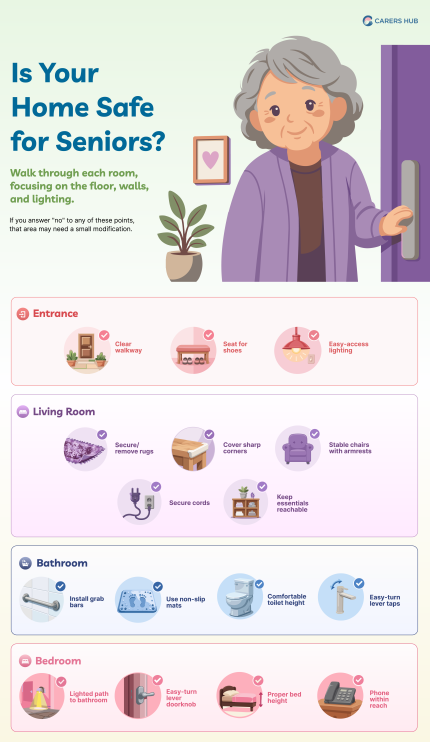
5 Simple Home Changes to Help Your Elderly Loved Ones Age Safely

Senior Citizen Discounts and Benefits in Singapore: Groceries, Transport